
Blog Page
Alkyd Resin Oil Length Categories: 5 Powerful Types
Introduction: Why Oil Length Determines Alkyd Resin Performance
For paint manufacturers, coating formulators, and procurement teams, choosing the right alkyd resin oil length category can directly affect drying speed, film hardness, gloss retention, flexibility, solvent compatibility, and long-term coating durability.
In simple terms, oil length refers to the amount of oil or fatty acid content in an alkyd resin. That percentage may look like a technical detail, but in actual paint formulation, it determines whether a coating dries fast enough for industrial production, remains flexible enough for exterior exposure, or brushes smoothly enough for decorative applications.
A resin selected for a metal primer in an industrial workshop should not behave the same way as a resin used for exterior gloss paint on doors, windows, timber, or coastal structures. One application may need hardness and fast solvent release, while another may need elasticity, weather resistance, and excellent brushing properties.
At Synresins Limited, we understand that the right resin choice is not only about chemistry. It is about matching resin performance to real coating conditions in East Africa, including high UV exposure, humidity, coastal salt air, temperature changes, and diverse application methods used by local manufacturers.
This guide explains the main alkyd resin oil length categories: very short oil alkyds, short oil alkyds, medium oil alkyds, long oil alkyds, and very long oil alkyds. It also shows where each category performs best in paint and coating formulation.
Table of Contents
- 1. What Is Oil Length in Alkyd Resin?
- 2. Why Oil Length Matters in Paint Formulation
- 3. Very Short Oil Alkyds: The Fast-Drying Specialist
- 4. Short Oil Alkyds: The Industrial Coating Choice
- 5. Medium Oil Alkyds: The Balanced All-Rounder
- 6. Long Oil Alkyds: The Decorative and Exterior Performer
- 7. Very Long Oil Alkyds: The Flexible and High-Oil Option
- 8. Alkyd Resin Oil Length Comparison Table
- 9. How to Choose the Right Alkyd Resin Oil Length
- 10. Why Oil Length Selection Matters in East Africa
- 11. Common Mistakes When Choosing Alkyd Resin Oil Length
- 12. Frequently Asked Questions
- Conclusion: Choose the Right Alkyd Resin Partner
1. What Is Oil Length in Alkyd Resin?
Oil length is the percentage of oil or fatty acid content used in the alkyd resin structure. Alkyd resins are polyester resins modified with oils or fatty acids, and the amount of oil used changes how the final coating behaves. This is why understanding alkyd resin oil length categories is important before choosing a resin for commercial paint production.
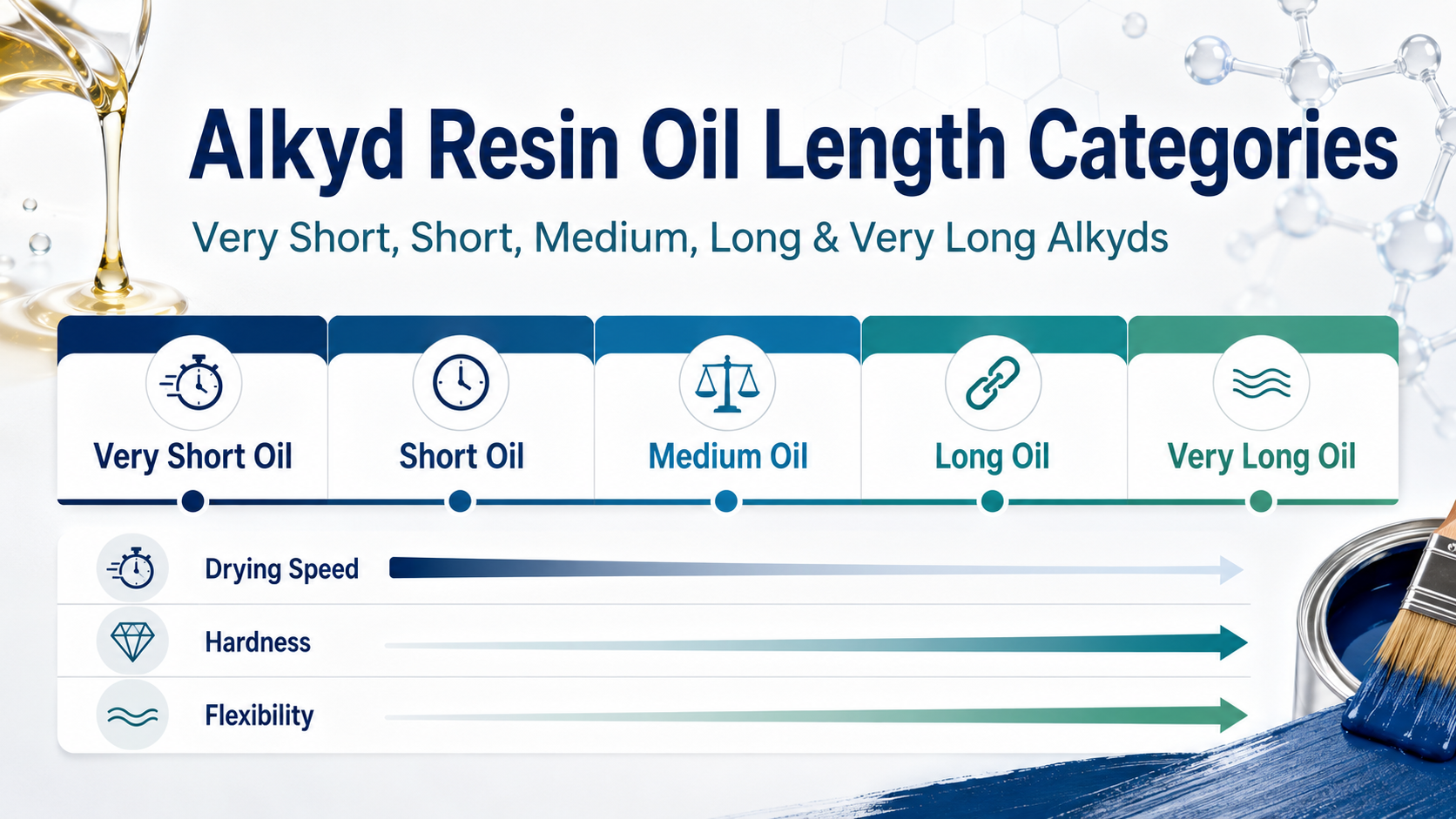
A lower oil length usually produces a harder, faster-drying resin. A higher oil length usually produces a more flexible, slower-drying resin with better brushability and improved exterior performance.
In paint manufacturing, alkyd resin oil length categories influence:
- Drying behavior: Whether the paint dries quickly or needs more time to cure.
- Film hardness: How tough and resistant the coating becomes after drying.
- Flexibility: How well the coating expands and contracts without cracking.
- Solvent compatibility: Whether the resin works better with aromatic or aliphatic solvents.
- Application method: Whether the coating is better for spraying, brushing, rolling, dipping, or baking.
- End-use performance: Whether the coating is suitable for metal, wood, machinery, decorative surfaces, or exterior exposure.
2. Why Oil Length Matters in Paint Formulation
Oil length is one of the most important decisions when formulating alkyd-based paints and coatings. It affects both the manufacturing process and the performance of the final product after application.
Drying Speed
Shorter oil alkyds generally dry faster because they contain less oil and form harder films more quickly. This makes them valuable in industrial environments where coated parts need to be handled, stacked, packed, or recoated within a short period.
Longer oil alkyds usually dry more slowly because they rely more on oxidative drying. However, this slower drying can be useful for decorative paints because it improves flow, leveling, brushability, and final appearance.
Hardness and Abrasion Resistance
Short and very short oil alkyd resins are preferred where hardness is critical. They are commonly used in industrial coatings, machinery finishes, metal primers, stoving enamels, and applications where the coating must resist mechanical stress.
Long oil and very long oil alkyds are softer by comparison, but they offer better flexibility and weatherability, making them suitable for exterior and decorative applications.
Flexibility and Weather Resistance
Higher oil content gives alkyd resins more flexibility. This allows the dry film to move with the substrate as temperature and humidity change.
This property is especially important for exterior coatings, wood coatings, marine coatings, and structures exposed to sun, moisture, and thermal movement.
Solvent Choice
Oil length also affects solvent compatibility. Short oil alkyds often require stronger aromatic solvents such as xylene or toluene, while long oil alkyds are usually more compatible with aliphatic solvents such as white spirit or mineral turpentine.
This matters because solvent choice affects cost, odor, VOC profile, drying behavior, application safety, and user experience.
3. Very Short Oil Alkyds: The Fast-Drying Specialist
Very short oil alkyd resins have the lowest oil content among common alkyd resin categories. They are designed for applications where fast drying, hardness, and production efficiency are more important than flexibility.
Key Characteristics
- Very fast drying: Suitable for production lines and coating systems where time is critical.
- High film hardness: Produces a tough, rigid film with strong mechanical resistance.
- Low flexibility: Less suitable for surfaces that expand, contract, or move regularly.
- Good compatibility with industrial systems: Often used with amino resins or in baking enamel systems.
Common Applications
- Baking enamels
- Stoving paints
- Industrial metal finishes
- Appliance coatings
- Fast-drying factory-applied coatings
4. Short Oil Alkyds: The Industrial Coating Choice
Short oil alkyd resins typically contain lower oil levels than medium and long oil alkyds. They are known for fast drying, high gloss potential, strong hardness, and good adhesion to properly prepared metal surfaces.
For manufacturers producing industrial coatings, primers, machinery paints, and automotive-related finishes, short oil alkyds are often the preferred option.
Key Characteristics
- Fast drying: Useful where coated items need quick handling or recoating.
- High hardness: Provides a durable film for industrial and metal applications.
- Good gloss: Can produce attractive finishes when properly formulated.
- Strong mechanical resistance: Suitable for surfaces exposed to abrasion and impact.
- Lower flexibility: Less ideal for exterior substrates that experience strong expansion and contraction.
Primary Applications in East Africa
- Metal primers: Short oil alkyds provide useful hardness and adhesion for industrial metal coating systems.
- Machinery coatings: Suitable for agricultural equipment, factory tools, and fabricated metal parts.
- Automotive primers and refinishes: Useful in systems where surface preparation, adhesion, and fast drying are important.
- Industrial spray coatings: Their drying behavior makes them suitable for controlled spray application.
5. Medium Oil Alkyds: The Balanced All-Rounder
Medium oil alkyd resins sit between short oil and long oil alkyds. They are often selected when a paint formulation needs a balance of drying speed, gloss, flexibility, hardness, and application ease.
This category is valuable because many coating applications do not require the extreme hardness of short oil alkyds or the high flexibility of long oil alkyds. Instead, they need dependable all-round performance.
Key Characteristics
- Moderate drying speed: Faster than many long oil alkyds but less aggressive than short oil systems.
- Balanced hardness and flexibility: Suitable for general-purpose coatings.
- Good gloss and appearance: Useful in enamel paints and maintenance coatings.
- Versatile formulation behavior: Can be adapted for brush, spray, or general coating applications.
Common Applications
- General-purpose enamels
- Maintenance paints
- Interior and exterior metal coatings
- Wood and metal finishes
- Protective coatings where balanced performance is needed
6. Long Oil Alkyds: The Decorative and Exterior Performer
Long oil alkyd resins have higher oil content, which gives them excellent flexibility, improved brushability, good wetting, and strong exterior performance. They are widely used in decorative paints, architectural coatings, wood finishes, marine coatings, and exterior gloss systems.
Where short oil alkyds are selected for speed and hardness, long oil alkyds are selected for workability, weather resistance, and a smoother application experience.
Key Characteristics
- Excellent flexibility: Helps prevent cracking when substrates expand and contract.
- Good brushability: Allows better flow and leveling during application.
- Strong surface wetting: Useful on wood, masonry, and aged surfaces.
- Good exterior durability: Suitable for outdoor applications when properly formulated.
- Slower drying: Requires careful drier selection and film thickness control.
Primary Applications in East Africa
- Decorative gloss paints: Ideal for doors, windows, trims, railings, and household finishes.
- Wood coatings: The resin can penetrate and wet wood surfaces effectively.
- Marine and coastal coatings: Useful in humid and saline environments where flexibility matters.
- Exterior maintenance coatings: Suitable for surfaces exposed to sunlight, rain, and temperature changes.
7. Very Long Oil Alkyds: The Flexible and High-Oil Option
Very long oil alkyd resins contain even higher oil levels than standard long oil alkyds. They are designed for applications where flexibility, penetration, wetting, and compatibility with mild solvents are highly important.
These resins are not usually selected where fast drying and high hardness are the main goals. Instead, they are useful in specialist coatings where high oil content gives better workability and movement tolerance.
Key Characteristics
- Very high flexibility: Useful where substrates move, expand, or contract.
- Excellent brushing and flow: Provides longer open time and smoother application.
- Good penetration: Useful for porous substrates such as timber and aged surfaces.
- Slower drying: Requires correct drier balance and formulation control.
- Lower hardness: Less suitable for high-abrasion industrial surfaces.
Common Applications
- Wood preservatives and wood finishes
- Flexible exterior coatings
- Marine-related coatings
- Specialty decorative finishes
- Coatings requiring excellent flow and penetration
8. Alkyd Resin Oil Length Categories Comparison Table
For technical managers, procurement officers, and paint formulators, the table below gives a practical comparison of the main alkyd resin oil length categories. Use this comparison to match each resin category with the right drying speed, hardness, flexibility, and application area.
| Category | Typical Oil Content | Drying Speed | Hardness | Flexibility | Best Applications |
|---|---|---|---|---|---|
| Very Short Oil Alkyd | Below 30% | Very Fast | Very High | Very Low | Baking enamels, stoving paints, industrial finishes |
| Short Oil Alkyd | 30% – 40% | Fast | High | Low | Metal primers, machinery coatings, industrial spray finishes |
| Medium Oil Alkyd | 45% – 55% | Moderate | Moderate | Moderate | General-purpose enamels, maintenance paints |
| Long Oil Alkyd | 55% – 70% | Slow to Moderate | Moderate | High | Decorative gloss paints, wood coatings, marine coatings |
| Very Long Oil Alkyd | Above 70% | Slow | Low to Moderate | Very High | Flexible exterior coatings, wood finishes, specialty coatings |
9. How to Choose the Right Alkyd Resin Oil Length
The right alkyd resin oil length depends on the coating’s end use, application method, substrate, drying requirement, solvent system, and expected exposure conditions. When comparing alkyd resin oil length categories, do not choose based on oil percentage alone. Match the resin to the real performance need of the paint product.
Choose Very Short Oil Alkyds When:
- You need very fast drying.
- The coating will be applied in a controlled industrial environment.
- The final film must be hard and resistant to handling.
- The product is designed for baking, stoving, or factory-applied finishes.
Choose Short Oil Alkyds When:
- You are formulating industrial coatings or metal primers.
- Fast drying and hardness are key selling points.
- The coating will be sprayed rather than brushed.
- The substrate is metal, machinery, or fabricated steel.
Choose Medium Oil Alkyds When:
- You need balanced drying, gloss, hardness, and flexibility.
- The product is a general-purpose enamel.
- The coating may be used on more than one substrate.
- You want a versatile resin category for broad formulation needs.
Choose Long Oil Alkyds When:
- You are formulating decorative gloss paint.
- Brushability, flow, and leveling matter.
- The coating will face outdoor exposure.
- The substrate needs flexibility, wetting, and weather resistance.
Choose Very Long Oil Alkyds When:
- You need maximum flexibility.
- The coating is designed for wood, porous substrates, or specialty exterior use.
- You need excellent penetration and brushing behavior.
- Drying speed is less important than application quality and movement tolerance.
10. Why Oil Length Selection Matters in East Africa
Paint and coating performance is strongly affected by local climate. A resin system that performs well in one market may fail earlier when exposed to East African conditions.
High UV Exposure
Many parts of East Africa experience strong sunlight throughout the year. Exterior coatings must therefore be formulated for gloss retention, color stability, and binder durability. Long oil and properly modified alkyd systems are often useful where exterior flexibility and weathering are important.
Humidity and Coastal Salt Air
In coastal environments such as Mombasa and Dar es Salaam, humidity and salt exposure can increase the risk of coating failure. Flexible coatings with good substrate wetting can help reduce cracking, moisture ingress, and premature peeling when properly formulated.
Thermal Movement
Surfaces expand during hot daytime conditions and contract during cooler periods. A coating that is too rigid may develop microcracks over time. This makes resin flexibility an important consideration for exterior architectural coatings.
Local Manufacturing and Supply Consistency
Reliable resin supply is critical for paint manufacturers. Delays, inconsistent resin quality, or unsuitable imported formulations can affect production schedules, batch consistency, and final product performance.
By sourcing from a local technical partner such as Synresins Limited, manufacturers can access resin solutions developed with regional performance needs in mind.
11. Common Mistakes When Choosing Alkyd Resin Oil Length
Selecting the wrong oil length can create production problems, performance failures, and customer complaints. Below are common mistakes formulators should avoid.
- Choosing based only on price: A lower-cost resin can become expensive if it causes drying problems, poor durability, or product returns.
- Using long oil alkyds for hard industrial films: Long oil alkyds are flexible, but they may not deliver the hardness needed for high-abrasion industrial surfaces.
- Using short oil alkyds for flexible exterior coatings: Short oil alkyds may be too rigid for substrates exposed to frequent thermal movement.
- Ignoring solvent compatibility: The wrong solvent system can affect viscosity, drying, application, safety, and film formation.
- Overlooking drying balance: Too much surface drying can lead to wrinkling, while slow through-drying can affect handling and recoating.
- Ignoring local climate: Resin selection should account for UV exposure, humidity, salt air, and substrate movement.
12. Quick Summary: Alkyd Resin Oil Length Categories for Paint Manufacturers
The easiest way to compare alkyd resin oil length categories is to connect each category to a formulation goal. Very short oil alkyds are selected for speed and hardness. Short oil alkyds are selected for industrial coating performance. Medium oil alkyds are selected for balanced enamel formulations. Long oil alkyds are selected for decorative, wood, marine, and exterior coatings. Very long oil alkyds are selected for maximum flexibility, wetting, and brushing behavior.
For paint manufacturers in Kenya and East Africa, alkyd resin oil length categories should also be evaluated against local conditions such as UV exposure, humidity, coastal air, substrate movement, solvent availability, and production requirements. The right choice of alkyd resin oil length categories can reduce defects, improve customer satisfaction, and help create more reliable paint products.
For additional technical reading on solvent emissions and coating formulation considerations, manufacturers can review VOC guidance from the U.S. Environmental Protection Agency.
13. Frequently Asked Questions
What are the main alkyd resin oil length categories?
The main alkyd resin oil length categories are very short oil, short oil, medium oil, long oil, and very long oil. Each category has different drying speed, hardness, flexibility, solvent compatibility, and application suitability.
What is the difference between short oil and long oil alkyd resin?
Short oil alkyd resins generally dry faster and produce harder films, making them suitable for industrial coatings and metal primers. Long oil alkyd resins are more flexible, easier to brush, and better suited for decorative, wood, marine, and exterior coatings.
Which alkyd resin is best for decorative paint?
Long oil alkyd resins are commonly used for decorative gloss paints because they offer good brushability, flow, leveling, flexibility, and exterior performance when properly formulated.
Which alkyd resin is best for metal primers?
Short oil alkyd resins are often preferred for metal primers and industrial coatings because they provide fast drying, hardness, and strong performance on properly prepared metal surfaces.
Why does oil length affect drying time?
Oil length affects how the resin cures and forms a film. Lower oil content usually supports faster drying and harder films, while higher oil content usually increases flexibility but slows drying.
Can one alkyd resin work for all paint applications?
No. A single alkyd resin cannot deliver the best performance across all applications. Industrial coatings, decorative paints, marine coatings, wood finishes, and maintenance paints each require different resin properties.
Conclusion: Choose the Right Alkyd Resin Partner
Understanding alkyd resin oil length categories is essential for producing paints and coatings that perform reliably in real conditions.
Choose very short oil alkyds when speed and hardness are critical. Choose short oil alkyds for industrial coatings, metal primers, and spray applications. Choose medium oil alkyds when you need balanced performance. Choose long oil alkyds for decorative, exterior, wood, and marine coatings. Choose very long oil alkyds where flexibility, wetting, and brushing performance are the priority.
The right choice depends on your formulation target, application method, substrate, solvent system, and local exposure conditions.
At Synresins Limited, our technical team supports paint manufacturers with resin solutions designed for regional manufacturing demands and East African coating environments. Whether you are developing industrial primers, decorative enamels, wood finishes, marine coatings, or specialty alkyd systems, choosing the right oil length is the first step toward better product performance.
Ready to Select the Right Alkyd Resin for Your Formulation?
Improve coating performance, reduce formulation failures, and strengthen your product quality with technical support from Synresins.
Contact Synresins Limited
Phone:+254 735 777 704 / +254 713 783 399
Email:info@synresins.com
Location: 18725 Lunga Lunga Road, Industrial Area, Nairobi, Kenya.